



On 8 June 2026, the EU Council cleared the adoption of EU’s new Foreign Investment Screening Regulation (FISR), which will reshape the framework for reviewing foreign investments on public order or security grounds. Published as Regulation (EU) 2026/1386, it will fully replace the FDI Screening Regulation (EU) 2019/452 from 17 January 2028. Since this regulation will necessitates reform at the member-state level, businesses and investors should begin preparing for the transition.
Background
The current FDI Screening Regulation, which has applied since October 2020, established an EU-wide framework for member states to screen foreign direct investment (FDI) that may affect security or public order. It also introduced a cooperation mechanism through which member states and the Commission can exchange information and raise concerns regarding investments under review in another member state.
While the Regulation led to the adoption and, in some cases, implementation of national investment screening mechanisms (ISM) in practically all EU member states, it left member states considerable discretion over the design of their national regimes. Significant differences emerged in relation to jurisdictional scope, screening procedures and timelines, so that diverging national screening practices and other shortcomings of the current system have become increasingly apparent. For businesses and investors, these differences have created an increasingly fragmented screening landscape, particularly in transactions involving activities or subsidiaries in several member states.
Against this background, and in response to evolving geopolitical risks regarding critical infrastructures, technologies and supply chains, the Commission proposed a revision of the framework in January 2024 as part of its broader European Economic Security Strategy. The revision was intended to close gaps in the existing system, strengthen coordination between national authorities and introduce greater harmonisation and procedures across the EU.
Negotiations between the EU institutions on the proposal concluded in a political agreement on December 2025. With the Council’s final adoption of the FISR on 8 June 2026 and publication of the Regulation on 26 June 2026, the legislative process at the EU level is now complete. The Regulation’s new minimum harmonisation requirements, however, must be incorporated into the national ISMs of EU member states during the 18-month transition period, which will trigger a further wave of national legislative reforms.
Key features of the new Foreign Investment Screening Regulation
The new FISR key features, including those that will have to be included in national member states ISMs, are:
Mandatory national screening mechanisms
The FISR requires all EU member states to establish national ISM for specified foreign investment. As every member state already has or is about to have a mechanism in place, the main effect is to prevent future abolition.
Mandatory minimum sectoral scope
Member states must now require prior authorisations for foreign investments falling under a mandatory minimum sectoral scope, which is defined as the EU target for the following activities (Art. 4 (15) FISR):
- Dual-use / military items: development, production or commercialisation of dual-use items listed in Annex I to Regulation (EU) 2021/821 and military goods or technology listed in the EU’s Common Military List (CML);
- AI, quantum, semiconductors: R&D in or production of certain listed emerging technologies in the fields of artificial intelligence, quantum technologies and semiconductors;
- Critical infrastructure / entities: activity in the transport, energy or digital infrastructure sectors and where the target is considered critical based on the member state’s risk-based assessment where the EU target is established
- Critical raw materials: activities in exploration, extraction, processing, recycling or recovery, or stockpiling of strategic raw materials listed in Section I of Annex I to Regulation (EU) 2024/1252 (Critical Raw Materials Act);
- Certain financial system entities: status of the target as a central counterparty (CCP), a central securities depositary, an operator of regulated markets or payment systems, or a global provider of specialised financial messaging services;
- Electoral infrastructures: ownership, development or operation of electoral infrastructures, such as voter databases or voting systems
The mandatory scope is defined by reference not only to sectors, but also to the specific activities carried out by the EU target. This provides greater precision than a purely sector-based approach. Some listed activities, however, remain broadly framed. For example, the “commercialisation” of dual-use or military items could bring a wide range of businesses within the screening regime, including companies that do not manufacture the relevant products themselves.
Member states remain free to add further sectors, which will necessitate a mandatory filing and prior authorisation requirements under their national regimes (Art. 4 (16) FISR).
Harmonised sector-specific risk factors
The FISR also requires member states and the Commission to consider whether a foreign investment could affect certain additional listed activities, including activities in sectors outside the mandatory minimum scope (Art. 19 (1) FISR). Although member states are not required to introduce prior authorisation requirements for these areas, many may choose to do so when adapting their national ISMs. The member states shall consider in particular the potential effects of the investment on a broad set of activities which include continuity, security or protection of supply in the following areas:
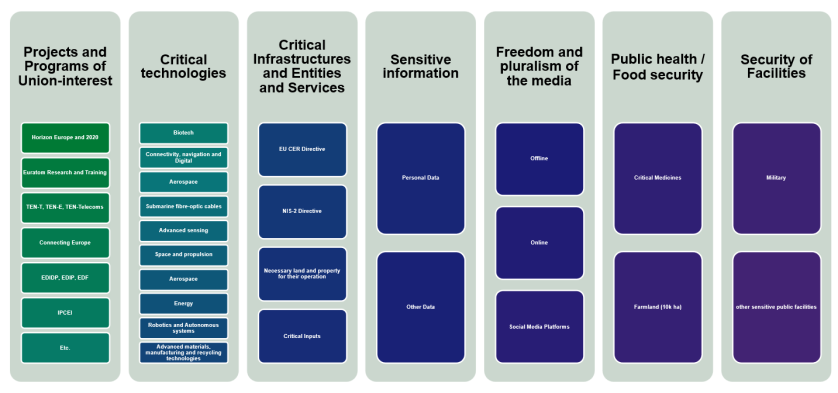
The above overview illustrates the broad range of factors that member states must consider when screening an investment. Notably, “projects or programmes of Union interest” may include initiatives involving cooperation with third countries, such as the UK or Japan. This broad definition may raise questions as to whether such projects should automatically receive heightened protection under the EU screening framework.
Harmonised investor-specific risk factors
The FISR expands and harmonises the investor-specific risk factors that member states and the Commission must consider during the screening process. These factors apply not only to the foreign investor, but also, in broad terms, to its beneficial owners and certain affiliated entities.
The relevant considerations under Art. 19 (2) FISR include whether the foreign investor:
- is likely to pursue a third country’s policy objectives, facilitate the development of a third country’s military capabilities, use the foreign investment to support internal repression in a third country or the commission of serious violations of human rights or international humanitarian law;
- has made a foreign investment that was previously screened by a member state and not authorised or only authorised subject to mitigating measures, which were significantly or repeatedly not complied with;
- has already been involved in activities negatively affecting the security or public order in a member state;
- has engaged in illegal or criminal activities, including circumventions of EU sanctions or anti-money laundering or financing of terrorism, or has relevant links to sanctioned persons;
- is subject to information sharing obligations under the laws of a third country without due process or oversight mechanisms;
- has an opaque ownership structure.
The expanded list places greater emphasis on the policies of the investor’s country of origin, its ownership and control structure, and the wider conduct and compliance history of the investor and its affiliates. Investor due diligence will increasingly extend beyond the transaction and include closer scrutiny of past investments, sanctions exposure, government links and compliance with previously imposed remedies.
To support these assessments, the FISR also provides for a database accessible to national screening authorities by 17 July 2026 (Art. 18 (6) et seq. FISR). The database will record previous screening decisions and information on compliance with conditions or mitigation measures, making an investor’s regulatory track record increasingly relevant in future transactions across the EU.
Harmonised sample mitigating measures
The FISR includes an article dedicated to the screening decisions taken by national screening authorities and notably a list of mitigating measures set out in Art. 20 (4) FISR, which authorities may impose to address risks to security or public order.
These measures include:
- Governance changes;
- Voting rights modifications;
- Access conditions re sensitive technology / information;
- Supply commitments;
- Continuity requirements;
- Sourcing requirements;
- Cybersecurity protocols;
- EU data storage and processing obligations.
While member states remain competent to decide cases, these measures are likely to drive a greater convergence in outcomes.
Mandatory minimum procedural alignments and the EU cooperation mechanism
The FISR introduces minimum procedural requirements designed to reduce differences between national ISMS and improve their coordination with the EU cooperation mechanism.
Key minimum requirements include:
- A two-phase screening process, consisting of an initial review (Phase I) and, where necessary, an in-depth investigation (Phase II), (Art. 4 (2) FISR);
- More closely aligned review periods, including a 45 calendar-day deadline Phase I. Phase II deadlines will remain governed by national law and may continue to differ between member states (Art. 4 (2) FISR);
- Call-in powers enabling member states to review certain non-notified transactions retrospectively (Art. 4 (4) and (5) FISR);
- Coordinated multi-jurisdictional filings, requiring foreign investors to submit filings on the same day, where transactions must be filed in multiple member states. The relevant member states must also endeavour to notify these to the EU cooperation mechanism on the same day (Art. 7 FISR)
These requirements are intended not only to reduce procedural fragmentation at national level, but also to support more effective coordination through the EU cooperation mechanism. The FISR specifies in greater detail which investments reviewed by national authorities must be referred to that mechanism. These include:
- investments where the EU target operates within the mandatory minimum sectoral scope and the foreign investor:
- is “controlled” by third-country governments or public body, including through ownership, funding, special rights or state-appointed representatives;
- is subject to EU sanctions;
- has a track record in the EU of blocked or restricted foreign investments in the EU.
- investments subject to a Phase II investigation where the EU target:
- participates in a project or programme of EU interest; or
- belongs to a group with one or more subsidiaries in another member state.
- investments that the screening member state intends to prohibit, unwind or approve subject to mitigation measures without opening a Phase II investigation.
- The screening member states opens an in-depth investigation (Phase II) and the EU target:
- is active in a project or programme of EU interest; or
- has one or more subsidiaries (on group level) in at least one EU member state.
- investments that the screening member state considers capable of negatively affecting security or public order in another member state (e.g. because the target has significant operations there).
The FISR also revises the timelines governing the EU cooperation mechanism. Under a set of interdependent deadlines, other member states and the Commission must generally submit any comments or opinions within a framework designed to conclude the process within 20 to 45 calendar days.
For transaction parties, these changes will make consistency and coordination across filings increasingly important. Information submitted in different member states will need to be aligned, and the involvement of the EU cooperation mechanism may affect both the scope and timing of national reviews, particularly for transactions involving sensitive sectors, multi-country operations or investors with state links or a previous screening history.
Intra-EU-transactions, greenfield investments and internal restructurings
The FISR extends beyond investments made directly by non-EU investors and covers investments made through EU subsidiaries controlled by a foreign investor (Art. 2 (1) FISR). Since many member states already screen certain intra-EU and, in some cases, purely domestic investments, the principal change may be that more such transactions will become subject to the EU cooperation mechanism.
Greenfield investments have not made it into the mandatory minimum scope. Member states remain free to bring them within their national ISMs (Art. 4 (17) FISR). Separately, the Commission’s proposed Industrial Accelerator Act would introduce screening requirements for certain greenfield investments in strategic sectors.
Internal restructurings, or reorganisations within the corporate group belonging to the EU target that does not change the target’s beneficial owner, fall outside of the scope of the FISR (Art. 1 (5) (b) FISR). National regimes and authorities, however, may differ in how they define an internal restructuring and whether a particular reorganisation is exempt from prior authorisation. Parties should continue to assess intra-group transactions on a jurisdiction-by-jurisdiction basis.
Implications for investors and next steps
The FISR seeks to strengthen the EU’s ability to identify and address security and public-order risks arising from foreign investment while preserving the EU’s openness to international capital. Whether it will achieve both objectives in practice will depend largely on how member states implement the new framework.
Investors should benefit from greater procedural alignment and a more predictable minimum framework, particularly for transactions requiring filings in several member states. The FISR, however, will not eliminate national differences. Member states may retain or introduce broader sectoral coverage, lower filing thresholds and reduce procedural requirements beyond the EU minimum.
The common minimum scope may lead to more, rather than fewer, filings in member states whose existing regimes do not cover all specified activities. National reforms may also extend beyond what is strictly required by the FISR, potentially increasing the regulatory burden for transactions that fell outside investment screening rules.
The full impact on transactions will become clearer as member states amend their national legislation during the 18-months-transition period. Businesses and investors should consider:
- monitor legislative developments in the relevant member states;
- reassess whether their activities and ownership structures fall within the expanded scope;
- identify potential multi-jurisdictional filings at an early stage;
- allow for coordinated filings and screening reviews in transaction timetables; and
- review investors’ ownership, government links, sanctions exposure and previous screening history as part of transaction due diligence.
Early assessment will be particularly important for transactions involving sensitive technologies, critical infrastructure, strategic supply chains or targets operating across several member states.
Moving forward
Foreign investment screening regimes are now in place across the EU and will continue to evolve as member states implement the FISR.
The CMS Expert Guide to Foreign Investment Screening Laws is your guide to foreign investment screening in key jurisdictions, providing a comprehensive overview of the relevant national legislation, the scope of each national regime, the targeted sectors, the highlights of the applicable procedure, the authorisation criteria and the potential risks of non-compliance.
For more information on the new FISR, contact your CMS client partner or the CMS experts who wrote this article.



