


Digital labels are becoming a noteworthy trend in the prepackaged food industry in the People’s Republic of China (“PRC”). Thanks to QR codes, these labels are transforming how consumers access product information, moving it from a static paper label on the product to an interactive digital experience. As businesses embrace this technology, the legal framework for digital labels is also taking shape at the same time. Especially the recent Notice on the Implementation of Digital Labeling for Prepackaged Foods released on 8 September 2025 (“Notice”) by the State Administration for Market Regulation and the National Health Commission, provided for more implementable requirements. This newsletter introduces the current legal framework for digital labels and outlines the key requirements.
1. Legal Framework for Digital Labels
China initiated its digital label pilot program in July 2023, testing it on selected prepackaged food products from certain companies. However, no public standards or guidelines were released at that time. Despite this, a digital label is in essence still a part of the food label itself. As such, it must strictly comply with the general requirements of relevant laws and regulations, such as the PRC Food Safety Law, PRC Advertising Law, PRC Law on the Protection of Consumers’ Rights and Interests and Measures for the Supervision and Administration of Food Labels. During the pilot process, the experience and lessons learned were incorporated into the newly revised national standard, GB 7718-2025 General Standards for the Labeling of Prepackaged Foods (“General Standards”, please see our newsletter for details: Transforming the Landscape: Recent Changes in Food Labeling Regulation). These General Standards, which will take effect only in March 2027, promote the use of digital labels and outline several key principles. The Notice was subsequently issued to help companies better implement digital labels during the transition period.
Overall, the use of digital labels on all pre-packaged foods remains voluntary for now. However, if a company chooses to adopt them, it must comply with the related regulations and national food standards.
2. Key Requirements for Digital Labels
The General Standards and Notice outlined the following requirements for digital labels.
a) Formatting and Readability
• Clarity of Identity: Digital labels must be provided through standardized digital means, either through self-owned digital platforms or contractual providers, that comply with national standards. Their identity must be clearly indicated near the digital label itself with the words “Digital Label” or a similar phrase. On 8 September 2025, a sample logo for digital labels (please see below) was released by China National Center for Food Safety Risk Assessment and GS1 China. Companies are encouraged to use this sample.
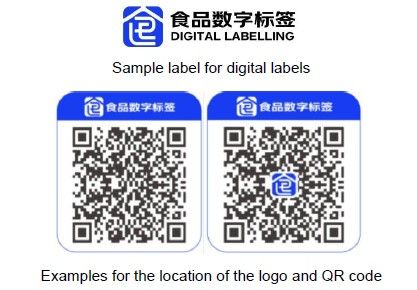
Companies are also encouraged to consolidate the digital label’s QR code with other QR codes, such as those redirecting to the brand’s social media, on the packaging, creating a single, unified code.
• Easy Access: Digital labels should be provided in a format that is easy for consumers to access. Companies are encouraged to support multiple recognition methods.
• Readability: The content of digital labels must be clear, prominent, and easy to read. Food producers can provide digital labels tailored to the needs of specific consumer groups. For example, in addition to text, information is also provided through video or audio formats to aid with readability.
• No Interference: It shall be displayed directly on the first landing page after scanning and shall not have any distracting elements that interfere with normal reading. Those overlapping or cluttered elements, pop-up windows, floating windows, or other distracting elements that hinder the consumer’s reading are not allowed.
b) Contents
• Consistency: Information on digital labels must be consistent with that shown on the physical labels. For special-purpose foods like health supplements, foods for special medical purposes, and infant formulas, the information on the digital label must match the content that has been officially registered or filed.
• Mandatory Content and Restrictions: A digital label is a digital representation of the physical food label. Therefore, its content must comply with Article 67 of the PRC Food Safety Law (i.e., the mandatory labeling items) and all mandatory labeling requirements specified in national food safety standards. Other information, such as advertising or marketing content, is not considered part of the digital label for the purpose of the Notice, because they are subject to other laws, especially the PRC Advertising Law.
• What to Include: While the physical label has limited space, the digital label can be used to display additional information. Businesses are encouraged to use digital labels for information that is permitted on prepackaged food labels by law, but may be limited by physical space. The Notice enumerated the following information on:
o Ingredient sources
o Production processes
o Origin
o Directions for use
o Product traceability
o Information on food safety and nutrition
It is crucial that food producers and operators are responsible for the truthfulness and accuracy of the content they display. The information must be objective and scientific, and it must not mislead consumers.
• Simplified Physical labels: Although the General Standards allow for simplification of physical labels if the mandatory items have been included on the digital label, currently there is only one provision on shortening the production address. If a digital label displays the full, detailed production address (e.g., “XX Province, XX City, XX County, XX Town, XX Road, No. XX”), the physical label on the packaging can be simplified to just the county-level administrative district name. For example, in the form of “XXX Producer (XX County)”.
• Traceable Modifications: The content of a digital label must not be tampered with. Thus, network security will be a concern for digital labels. When making modifications or updates, businesses must record all changes, including the content of the modification, the time it was made, and the person who made it. This ensures that the entire information change process is traceable.
3. Generate Digital Labels for Prepackaged Food Products
Companies can generate their own digital labels in one of two ways:
• One option is to use the unified platform from the Automatic Identification Manufacture Association of China. By visiting https://d-label.org.cn/home, logging in, and following the user manual, you can generate a digital label QR code for your food products. This platform is developed under the auspices of the National Health Commission and China National Center for Food Safety Risk Assessment and thus has less compliance risk. The platform also showcases several examples of existing digital labels for reference.
• The second option is for a company to use other third-party platforms or build its own. In this case, the digital label QR code must be generated and applied to the food label in compliance with the requirements of General Standards and the Notice. A national standard for digital labels is currently under discussion and being drafted. Companies building their own platforms should stay informed about these ongoing developments.
4. Conclusion
While the basic requirements for digital labels are in place, some key points remain unclear, such as whether physical label font height standards apply, what is the required size and location and how much the physical label can be simplified. More detailed requirements and national standards are awaited. Nevertheless, for multinational food and beverage companies, digital labels still present a unique opportunity. By adopting digital labels on imported or locally produced products in China, either through an in-house system or a service provider, food manufacturers can not only save space and refine packaging design, but also offer richer product information and enhanced consumer experiences. However, it is crucial to recognize that digital labels operate within a complex regulatory framework. Beyond the specific requirements we have discussed, their content is also subject to general national labeling standards and advertising laws. Food labeling is becoming more intricate and specialized. Companies need to establish and enhance standard operation procedures for label compliance check, so as to transform this opportunity into a long-term strategic advantage, rather than a regulatory risk.