Key facts
Capital: Budapest
Land area: 93 030 sq. km
Population: 10 032,375 (July 2004 est)
Railroads: 7897 km
Highways: 188 203 km
Political overview
Hungary has been a stable political entity since the socio-economic transformation process began in 1989. The large number of political parties at the beginning of the changes have consolidated, and only four parties successfully met the minimum 5% threshold to get into the Hungarian Parliament during the 2002 elections. The Hungarian political arena is currently bipolar. The conservative right consists of two parties, the Viktor Orban-led Young Democrats (FIDESZ), and the Forum of Hungarian Democrats (MDF); the socialist-liberal pole includes both the Hungarian Socialist Party (MSZP) and Alliance of Free Democrats (SZDSZ).
Economic overview
Hungary has made the transition to a market economy, with a per capita income one-half that of the Big Four European nations. Hungary continues to demonstrate strong economic growth and joined the European Union in May 2004. The private sector accounts for over 80% of GDP. Foreign ownership of and investment in Hungarian firms is widespread, with cumulative foreign direct investment totalling more than $23 billion since 1989. Hungarian sovereign debt was upgraded in 2000 to the second-highest rating among all the Central European transition economies. Inflation has declined substantially, from 14% in 1998 to 4.7% in 2003; unemployment has persisted around the 6% level. Germany is by far Hungary's largest economic partner. Short-term issues include the reduction of the public sector deficit to 3% in 2004 and avoiding unjustified increases in wages.
Economic summary
Indicator
2001
2002
2003
GDP growth (% on previous year)
3.8
3.3
2.8 (est)
Consumer price Inflation- (%)
9.2
5.3
4.7 (est)
Account deficit (% of GDP)
6.2
7.1
9
Foreign direct investment
3.9
2.9
2.5
Unemployment
5.7
5.8
5.8
Credit Rating
A+
A+
A+
Foreign direct investment
Hungary has been highly successful in attracting foreign direct investment particularly in the electronic, retail, consumer goods, automotive and telecom sectors.
Capital and earnings can in almost all instances be freely repatriated. For most purposes the Forint is freely exchangeable, although the National Bank of Hungary retains some exchange controls, particularly for large capital movements.
Buying power
Highly trained professionals in multinational companies can expect something approaching international level salaries, while unskilled workers in economically depressed areas may receive little more than the minimum wage.
Imported goods are valued around £19 billion a year. The most important are machinery and equipment, fuel and electricity. The IT sector is growing fast. As a result, computers and software are much sought after.
Increased purchasing power is a result of rising nominal wages. For some industries, countries that continue to offer cheap labour may become more attractive.
Vehicle ownership is relatively high for the Central Eastern European region but relatively low by Western European norms.
The government incentives have encouraged Hungarians to invest in newer and better quality housing.
Health and personal care are still a market with considerable potential for growth since by international standards Hungarians spend relatively less on cosmetics and personal care products. It is a steady 11% of spend.
Government
Hungary is a parliamentary democracy.
Peter MEDGYESSY has been Prime Minister since 27 May 2002 and represents the Hungarian Socialist Party (Magyar Szocialista Part). The next parliamentary elections are scheduled for April 2006. There are two main political parties: Hungarian Socialist Party or Magyar Szocialista Part (MSZP) [Laszlo KOVACS, chairman]; and Hungarian Civic Alliance or Fidesz-MPP [Viktor ORBAN, chairman].
General information
Geography
Hungary can be found in Central Europe, east of Austria, and borders Austria, Croatia, Romania, Serbia and Montenegro, Slovakia, Slovenia and Ukraine.
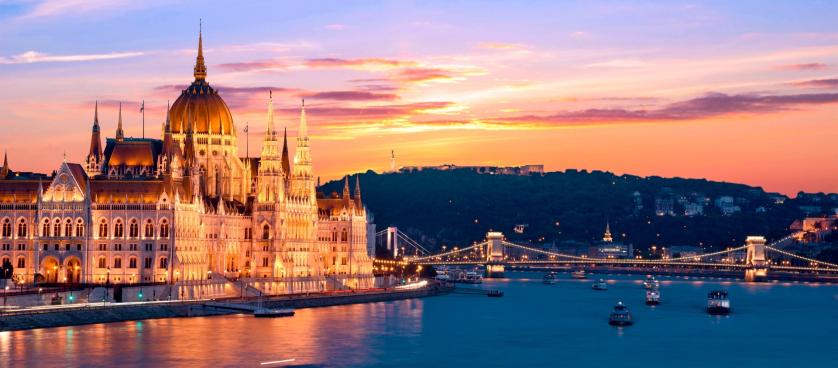
Hungary has 10.3 million inhabitants, and has a total area of approximately 93,000 square kilometres. The capital of Hungary is Budapest, which is the business and manufacturing centre of the country. Budapest is famous for its buildings, its style, and its social and intellectual life.
It is landlocked and has a strategic location astride main land routes between Western Europe and the Balkan Peninsula as well as between Ukraine and the Mediterranean basin. The north-south flowing Duna (Danube) and Tisza Rivers divide the country into three large regions.
Climate
Temperature in Budapest:
- Mean 11.5 ºC
- Maximum 35.6 ºC
- Minimum -11.5 ºC
Precipitation 550 mm
Temperate; cold, cloudy, humid winters and warm summers
Natural resources
Bauxite, coal, natural gas, fertile soils, arable land
Population
Although life expectancy continues to increase, nevertheless deaths exceed births due to the low level of births and an average family size of 2.57. The effect of this is an ageing population profile.
The population is concentrated to into the capital city, Budapest (1,778,000) of the major cities non has a population greater than 250,000.
(Data sources: EU - 2003 Estimate from Economist Intelligence Unit, Individual Credit Ratings Agencies)