Ofgem Review Final Report: A reset for the GB energy regulator






New duties, a redrawn regulatory perimeter, and a materially expanded enforcement toolkit – most of it requiring primary legislation.
On 22 April 2026 the Department for Energy Security and Net Zero (DESNZ) published the final report of its Ofgem Review (the Review) – the first comprehensive review of the regulator since its creation in 2000. The report sets out a significant package of reforms intended to ensure Ofgem is and remains “fit for the future”. It has meaningful implications for every licensed participant in the Great Britain energy market and for those investing in, lending to or acquiring them together with those performing the more nebulous range of energy sector activities that fall outside the sector licensing regime but nevertheless fall under Ofgem’s purview via other regulatory routes.
1. The reforms at a glance
- Three principal objectives will replace Ofgem's single, overriding consumer protection objective: consumer interests, net zero, and economic growth will sit on an equal statutory footing.
- Financeability and competition cease to be stand-alone duties but will remain relevant considerations – framed through a new Ofgem-specific Strategy and Policy Statement (SPS).
- An Energy System Value Chain (ESVC) concept gives the Secretary of State power to designate Ofgem as regulator of new activities without primary legislation each time – ending the current technology-by-technology licensing model as being seen for example recently on “load control” and heat networks.
- Ofgem will gain enforcement powers against interconnected (i.e. within the same corporate group) companies (including foreign parents) where they have caused, or put at risk of causing, a regulated entity's breach – i.e. Ofgem can pierce the corporate veil. This will impact governance structures (both for wholly owned projects and joint ventures), day-to-day asset management and, potentially, operation and maintenance solutions.
- Penalty ceilings will be reformed to ensure there is no gain from breach even where the breaching entity has little or no turnover (an issue highlighted by historic Capacity Market cases).
- New powers to hold senior executives personally accountable (an Individual Accountability Mechanism) and to prohibit or claw back bonuses in the most serious cases.
- Direct consumer law enforcement – Ofgem will no longer have to go through the courts.
- Most of the headline reforms require primary legislation “when parliamentary time allows”. Ofgem consultation is required before several of the new powers can be deployed.
2. Overview of the Review – scope, process and the six strategic outcomes
The Review was announced with a Call for Evidence in December 2024. It was led by DESNZ officials supported by an Independent Advisory Panel of external experts, and drew on a wide range of engagement with stakeholders. It was deliberately aligned with the Department for Business and Trade’s Regulation Action Plan and the Defra-commissioned Independent Water Commission chaired by Sir Jon Cunliffe.
Importantly, the Review examined Ofgem as a regulator and as an organisation, not the detailed regulatory framework that Ofgem itself administers. The report does not assess individual rules, licence conditions or specific regulatory decisions; where examples are referenced, they are cited as evidence of the broader patterns the Review identifies.
The seven core objectives examined
The Terms of Reference required the Review to test whether Ofgem was fit for a fast-changing, decarbonising market across seven areas:
- Redefining regulatory boundaries
- Clarifying Ofgem’s mandate and duties
- Strengthening consumer protection and service standards
- Assessing and reforming regulatory powers
- Enhancing skills and capability
- Supporting economic growth and net zero
- Improving transparency and scrutiny
Stakeholder feedback sets out the challenge: a complex and growing statutory framework that blurs strategic focus, an evolving sector that has outgrown the 2000-era legislative architecture, outdated prescriptive rule-making, an ever-expanding remit that includes significant scheme delivery, and capability and cultural challenges that have hindered engagement with industry.
The six strategic outcomes
In response, the Review organises its recommendations around six strategic outcomes:
- creating a more strategic, outcomes‑focused regulator by streamlining duties and replacing the current Strategy and Policy Statement (SPS) with an Ofgem-specific SPS (alongside a separate NESO SPS);
- clarifying the system and Ofgem’s remit through the new Energy System Value Chain (ESVC) and an Energy Systems Guidance Framework, signalling a refocus on core regulation and potential migration of scheme delivery;
- building a high‑performing, expert organisation via a skills audit, cultural and capability transformation, and stronger industry expertise;
- empowering Ofgem to protect and promote consumer interests through a materially expanded enforcement toolkit (including direct consumer law enforcement, an Individual Accountability Mechanism (IAM) and remuneration clawback, penalty cap reform, faster licence modification and reach to interconnected companies, in addition to strengthened consumer redress and Energy Ombudsman reforms);
- enabling innovation, investment, growth and the clean transition through more proportionate, outcomes‑based regulation including General Authorisation Regimes and targeted licensee derogations; and
- improving transparency and accountability via clearer KPIs and strengthened scrutiny, including independent performance audits.
What the Review does not propose
Several points of scope are worth noting up front because they shape what the reforms will and will not do:
- No full FCA-style Senior Managers Regime. The Review concludes direct replication of the FCA regime would not be proportionate for the energy sector; a lighter-touch IAM is proposed instead.
- No general FCA-style Consumer Duty. The evidence did not support the additional burden over existing Standards of Conduct rules, particularly given the proposed shift to more outcomes-based regulation.
- No general quasi-automatic penalty regime for ‘minor’, but clear, licence breaches. The Review found no compelling case for a general power to levy quasi-automatic penalties, but does support the ability to easily enforce against Third Party Intermediaries (TPIs).
- No redrawing of the lines of Ofgem’s independence. Whilst a new Ofgem-specific SPS will be introduced and a mechanism will be introduced for Ofgem to request guidance, Ofgem remains operationally independent and accountable to Parliament.
- No change to Ofgem’s legal status…yet. Whether Ofgem should move away from its current non-ministerial government department status (as raised by some stakeholders, citing the FCA and NDA as comparators) remains under review.
With that architecture in mind, we set out below what we consider to be some of the key reforms proposed under the report, set to have the biggest impact on the GB energy market.
3. A streamlined duties framework – the end of the single overriding objective
Since 2000, Ofgem has been required to act with an overriding principal objective to protect the interests of existing and future consumers, alongside a growing list of primary and secondary duties accumulated via successive energy Acts. By the Review’s own count, the number of primary duties has roughly tripled since creation.
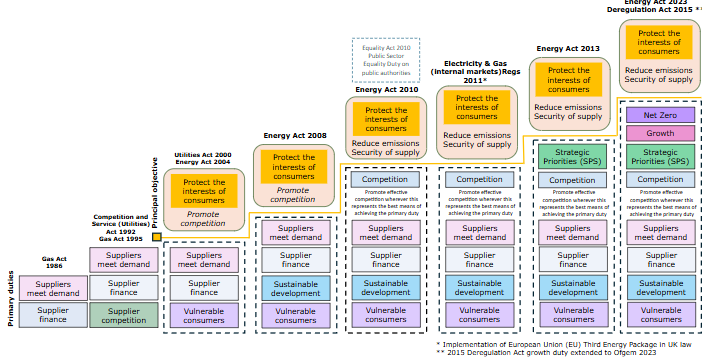
The government’s view is that this has left Ofgem trying to balance too many, sometimes conflicting, obligations – with the overriding objective also driving short-term, bill-focused decisions that defer necessary investment and generate higher costs over the longer term. This is something many market participants will agree with, and the obligations often come into conflict.
Outcome 1 of the Review therefore recommends a three equal principal objectives structure:

The stand-alone primary duties of financeability (the duty to have regard to the need for licensees to be able to finance their activities) and promotion of effective competition are to be removed, however. the Review makes clear that both will remain important outcomes Ofgem must take into account. Going forwards however, Ofgem will have greater flexibility in how and where these are weighted – informed by the reformed SPS.
The duty to secure licensees’ ability to finance activities has long been a load-bearing element of the RIIO price control architecture and the enhanced investability test; central to challenges and appeals in previous price control rounds. It’s removal as a stand-alone primary duty is a legally meaningful change even if DESNZ’s stated policy intent is that financeability remains fully considered via the reformed SPS.
4. The Energy System Value Chain (ESVC) – an end to technology-by-technology regulation
Today, Ofgem’s regulatory perimeter is defined in primary legislation by reference to specific activities (from historic bedrocks of the regulatory structure such as gas supply, electricity generation, transmission, distribution to new activities introduced over time such as smart meters heat networks, hydrogen, load control and so on). Extending the perimeter – for example to capture TPIs – has historically required fresh primary legislation, which is slow and often reactive against a rapidly changing set of activities, services and organisations across all aspects of the sector – from the domestic “prosumer” operating generation and flexible assets to the reformed independent system operator and planner role of our national energy system operator.
Outcome 2 of the Review introduces the ESVC, a new policy concept intended to map the full range of activities involved in producing, delivering and using energy. The Secretary of State will be given the power to appoint Ofgem as regulator for activities falling within the ESVC, with Ofgem required to consult and DESNZ able to bring in regulation where it is warranted and Ofgem is the appropriate body.
To support the operation of the ESVC, the Review proposes an Energy Systems Guidance Framework which will guide the interpretation of Ofgem’s reformed duties and regulatory decisions, embedding the desired consumer outcomes and setting out clear roles and responsibilities across the value chain.

The ESVC is best considered as a framework for what could be regulated rather than an immediate expansion of Ofgem’s remit. It will enable co-ordinated anticipatory regulation – particularly relevant as installation, storage, flexibility services, EV charging and local energy systems proliferate – and is explicitly paired with closer collaboration with other regulators.
5. A reshaped enforcement toolkit
Outcome 4 of the Review recommends a significant expansion of Ofgem’s enforcement powers. Taken together, these reforms would provide Ofgem with greater powers to act in more circumstances, against individuals and interconnected companies, and with speed and higher penalty caps. These changes are similar to recent reforms of the CMA and FCA.
The below table gives a high-level overview of the key proposals in respect of Ofgem’s expanded enforcement powers:
| Reform | What it does |
| Enforcement against interconnected bodies corporate | New power to enforce against parent or group companies (including foreign-owned) where they have had a direct role in causing the regulated entity to breach, or to be at risk of breaching, its obligations. Redress must first be sought through the licensee. Appeal route to be introduced. |
| Individual Accountability Mechanism (IAM) | Lighter-touch version of FCA’s Senior Managers Regime. Licensees designate senior management functions; individuals can be personally sanctioned, including after leaving the licensee, and in the most serious cases blacklisted from working in the sector. |
| Executive remuneration clawback | Power (modelled on Ofwat powers under the Water (Special Measures) Act 2025) to direct companies to prohibit or recover performance-related pay in cases of extremely serious breaches. |
| Penalty ceiling reform | Removes the perverse outcome (seen in historic Capacity Market cases) where low- or no-turnover entities escape meaningful financial penalties despite the 10% turnover cap. New regime will ensure there can be no gain from breach. |
| Direct consumer law enforcement | Removes need for Ofgem to seek enforcement orders through the courts (mirroring CMA powers under the Digital Markets, Competition and Consumers Act 2024). |
| Provisional / Final Order deadlines | Deadline for imposing penalty alongside a PO/FO extended from 3 months to 15 months for the whole order-to-penalty process. |
| Urgent licence modifications | Expedited gas/electricity licence modification process extended beyond the current narrow MHHS-related use in section 11AA Electricity Act 1989 – still with mandatory consultation but without the 56-day standstill where Ofgem considers it necessary or expedient. |
| Quasi-automatic TPI penalties | Targeted power for clear-cut breaches by TPIs only (e.g. failure to provide information, failure to implement ADR decisions). No general quasi-automatic regime. |
6. Spotlight: Interconnected (i.e. within corporate group) Bodies Corporate
The introduction of the power to transfer liability to an interconnected company (including foreign-owned interconnected companies), set out in Outcome 4 of the Review, is potentially the most significant change for investors in regulated energy assets. At present, Ofgem’s sectoral enforcement powers directly reach only the licensed entity. Corporate structures – often adopted for entirely legitimate commercial reasons – can mean a regulated entity exists “on paper” while critical decisions, assets and value sit within either: (i) an unregulated chain of holding companies elsewhere in the group; or (ii) upstream joint ventures.
The proposed power would:
- allow Ofgem to transfer liability to a corporate group company (including foreign-owned companies) that has had a direct role in causing the regulated entity to breach (or to be at risk of breaching) its obligations;
- require Ofgem first to seek redress via the directly regulated entity; and
- be accompanied by a mandatory Ofgem statement of policy and appeal mechanisms.
Compliance within complex structures. Many renewable energy projects – wind farms, solar farms and BESS – are held in special purpose vehicles (SPVs) that form part of intricate, interconnected corporate structures, often involving multiple layers of service providers, holding companies, debt, investors and cross-border ownership.
The proposed new interconnected-company power raises questions for these arrangements: which entities within the structure could be treated as having a “direct role” in causing a breach, and how should internal governance and management services be configured to manage the risk of upstream liability? What constitutes a “direct role” is going to be of fundamental importance and could potentially impact the investability of UK projects (i.e. when compared to more permissive regulatory frameworks across Europe that may be perceived to encourage and support investment by private capital). By way of example where this could impact, and that needs to be examined:
- Many regulated licensees are held, directly or indirectly, via joint venture structures where key decision making is subject to reserved matter approval being obtained under the shareholders’ agreement governing the licenced entity. The extent to which the exercise by a shareholder of positive control (i.e. the ability to ensure that a particular action is taken) or negative control (i.e. the ability to block something from happening) will be key.
- Leaving aside regulated networks, it is rare for licensed entities in the UK to appoint independent non-executive directors – the majority of directors of licensed entities comprise either management or directors appointed by the ultimate sponsors. By supporting, or having regard to, the objectives of their appointing shareholders (which is a common feature of shareholders’ agreements), would that amount to a direct or indirect shareholder having a “direct role”?
- Day-to-day asset management is often carried out via service agreements (e.g. asset management agreements, management services agreements, development services agreements, construction management agreements) where an affiliate of the licenced entity (or a shareholder in the licenced entity) performs the services, and it is increasingly common for operation and maintenance to be conducted “in-house” on a similar basis. The extent to which managing a project company (or undertaking operation and maintenance activities) could amount to a “direct role” will impact both project deliverability and overall management strategy.
Ofgem’s proposal would have the effect of piercing the corporate veil and exposing direct and indirect shareholders’ to, potentially, significant risk. Sponsors and investors will need to map their structures against the forthcoming Ofgem statement of policy and build compliance frameworks that address the specific touchpoints between SPVs and their interconnected affiliates.
What constitutes a “corporate group” is not defined. Clearly this is anticipated to capture group undertakings (i.e. within the meaning of the Companies Act 2006), but the report is silent as to whether: (i) investment managers and portfolio companies / investee companies would be seen to form part of the same corporate group; or (ii) a substantial minority shareholder of a licensee would be considered to form part of the same corporate group as the licensee.
There is no further detail on key aspects of what the regime may look like, and how to ensure that arrangements are structured appropriately to account for the risk and potential liabilities.
7. Supporting innovation – targeted licence derogations
The Review recognises that Ofgem’s current prescriptive licensing framework, while providing important consumer safeguards, can unduly limit innovators’ ability to bring new products and services to market. Licence conditions often require activities to be conducted in specified ways or prohibit certain activities entirely, creating barriers to entry for new business models and technologies.
To address this, outcome 5 of the Review recommends enhancing Ofgem’s ability to grant targeted licence derogations, allowing it to:
- Permit time‑limited or entity‑specific departures from licence conditions
- Support regulatory sandboxes, pilots and trials without requiring market‑wide licence changes
- Enable innovators to test new services, tariffs, technologies or delivery models
- Provide flexibility without diluting core consumer protection standards
The aim is to make regulation more agile and innovation‑friendly - supporting Ofgem’s growth duty and the UK’s ambition to capitalise on its world-leading innovation ecosystem - subject of course to appropriate safeguards, consultation and enabling legislation. The reforms are therefore framed as a controlled flexibility mechanism, rather than deregulation.
For licensees, this represents an opportunity to engage proactively with Ofgem on innovation proposals; for investors, it signals a regulatory framework increasingly designed to support rather than stifle commercial dynamism.
How this more flexible and bespoke approach would be managed sufficient efficiently by Ofgem against considerable potential demand for its usage and finite resources it seems to us will be a key practical obstacle.
There is also noteworthy silence in the report on another angle of attack on this area – that of widening innovation via class or project specific licence exemption. Against policy workstreams in, for example, opening up electricity network infrastructure operation to wider ownership and the use of supply licence exempt electricity supply in widened and novel areas, the exercise of existing licence exemption powers is frequently cited as an avenue available in the policy armoury. However, the reality is often timescales and processes in this area seen as too uncertain and labour intensive. Perhaps ultimately the movement of this area from central government to Ofgem was seen as too much of a structural move even for the level of reform proposed in this report.
8. Implementation pathway and timing
Annex B to the report provides a consolidated list of 38 specific actions arising from the Review, a substantial proportion of which require primary legislation.
The actions can be viewed as falling into four main delivery buckets. This division is significant, as the reforms that matter most to investors largely fall within the ‘’primary legislation and ‘Ofgem’s consultation and rule-making’ streams, meaning that full implementation is unlikely in the immediate future. Legislative changes will be introduced “when parliamentary time allows” (a turn of phrase that often not been good news on pace of reform in the past), with consultation and staged commencement expected over the remainder of this Parliament, not all at once. So timelines are vague at best.
The table below gives an overview the Review’s action and their delivery pathways, showing which reforms are likely to move quickest and which will be dependent on parliamentary time and subsequent Ofgem consultation.
| Delivery bucket | Examples | Timing signal |
| Primary legislation | Streamlined duties; ESVC designation power; interconnected-company enforcement; IAM; bonus clawback; penalty cap reform; direct consumer law enforcement; PO/FO deadline extension; expedited licence modification; Ofgem-specific SPS framework | “When parliamentary time allows” – no fixed date |
| Secondary legislation and designations | New Ofgem-specific SPS designation; NESO-specific SPS; designation of ESVC activities; new Guaranteed Standards of Performance | Following primary legislation (with some GSoP instruments already in force) |
| Ofgem consultation and rule-making | IAM design (senior management functions, scope, proportionality); bonus clawback rules; statement of policy on interconnected-company enforcement; updated KPIs; licence application guidance for innovators | Ahead of deployment of each new power |
| Ofgem operational and cultural change | Forward-looking skills audit; workforce plan; Cultural and Capability Transformation Plan (H2 2026); industry engagement reset; 25% administrative burden reduction; Warm Homes Agency scheme transition | Underway now; iterative through Parliament |
The division between delivery categories is significant, as the reforms that matter most to investors are largely situated within the primary legislation and Ofgem’s consultation and rule-making streams, meaning that full implementation is unlikely in the immediate future. Legislative changes will be introduced “when parliamentary time allows”, with consultation and staged commencement expected over the remainder of this Parliament, not all at once.
The below diagram gives a high-level anticipated timeline for the ‘next steps’ coming out of the Review:

9. What it means for the sector
The reforms will affect different market participants in different ways. While many measures – particularly the strengthened enforcement toolkit – apply in principle across all licensees, the following paragraphs highlight key aspects to each sector.
Generators (including renewables, storage and dispatchable)
Generators should particularly note (i) the penalty cap reform, (ii) the more flexible ESVC-based regulatory perimeter, and (iii) the stronger interconnected-company power (given the prevalence of widely held corporate holding structures, affiliated service providers and EPC/O&M affiliates). Ofgem’s continuing focus on networks, connections reform and strategic investment – reinforced by the new net zero and growth objectives – is likely, on balance, to be supportive of generation investment, albeit potentially requiring different holding and resourcing structures.
Networks
The duties reform appears most consequential to networks. The removal of the stand-alone financing duty is legally significant, but the government’s stated intention is that financeability will remain a primary consideration through the SPS, reinforced by the new equal-footing growth objective. The continuing direction of travel towards strategic, anticipatory network investment (RIIO, ASTI, strategic spatial energy planning, connections reform) remains firmly in place.
Suppliers and retail market participants
Suppliers face the most concentrated package of new obligations: direct consumer law enforcement, the IAM, bonus clawback, expanded GSoPs, Energy Ombudsman reform with enforceable decisions, the extended provisional and final order regime, and the expedited licence modification process. Financial resilience rules (minimum capital requirement, Financial Responsibility Principle, credit balance ringfencing) remain – and will now sit alongside upstream enforcement reach via the interconnected company power.
10. Our view
The Review is a serious and considered piece of work. It forms part of a co-ordinated attempt to reshape the institutional architecture of GB energy for the clean-power transition.
The direction of travel is clear: faster, more agile, more deterrence-based regulation; a more clearly articulated political-regulatory interface through the SPS; and a regulator with the statutory reach to address group-level conduct, individual accountability and previously unregulated activities along the value chain.
For investors, much of this will be welcome in principle – clearer strategic steers, a new growth objective on equal footing, and continued regulatory support for network investment. But the reforms also introduce new risks – particularly the interconnected company power, the IAM and bonus clawback, and the scope to more quickly bring sector activities within the requirement for a licence – that will need to be factored into transaction structuring, governance and internal controls.
With most of the headline reforms still requiring primary legislation, and extensive Ofgem consultation to follow, the coming 12 to 24 months will be critical. We will continue to monitor developments closely but, in the meantime, if you would like to discuss how the proposed changes could affect your regulatory risk, governance arrangements or transaction structuring, please get in touch.